Are Sitting Position and Working Duration Associated with Low Back Pain in Workers?: A Meta-Analysis
Abstract
Background: Low back pain (LBP) is general
Adhikari B, Ghimire A, Jha N, Karkee R, Shrestha A, Dhakal R,Niraula A, et al. (2021). Factors associated with low back pain among construction work-ers in Nepal: A cross-sectional study. PLoS ONE 16(6): e0252564. https://doi.org/10.1371/journal.pone.0252564. study. BMC Musculo-skelet Disord. 18(1): 334. https://doi.-org/10.1186/s12891-017-1686-y. http://doi.org/10.1186/s12889-021-10893-8. sixth Korea National Health and Nurtrition Examination Survey. SPINEE. 529-9430 (18). http//doi.org/10.1016/j.spinee.2018.04.003. in working adults: A cross-sectional study. J of Epidemiol. 27(9):401-407. http://dx.doi.org/10.1016/j.je.2016.08.019. 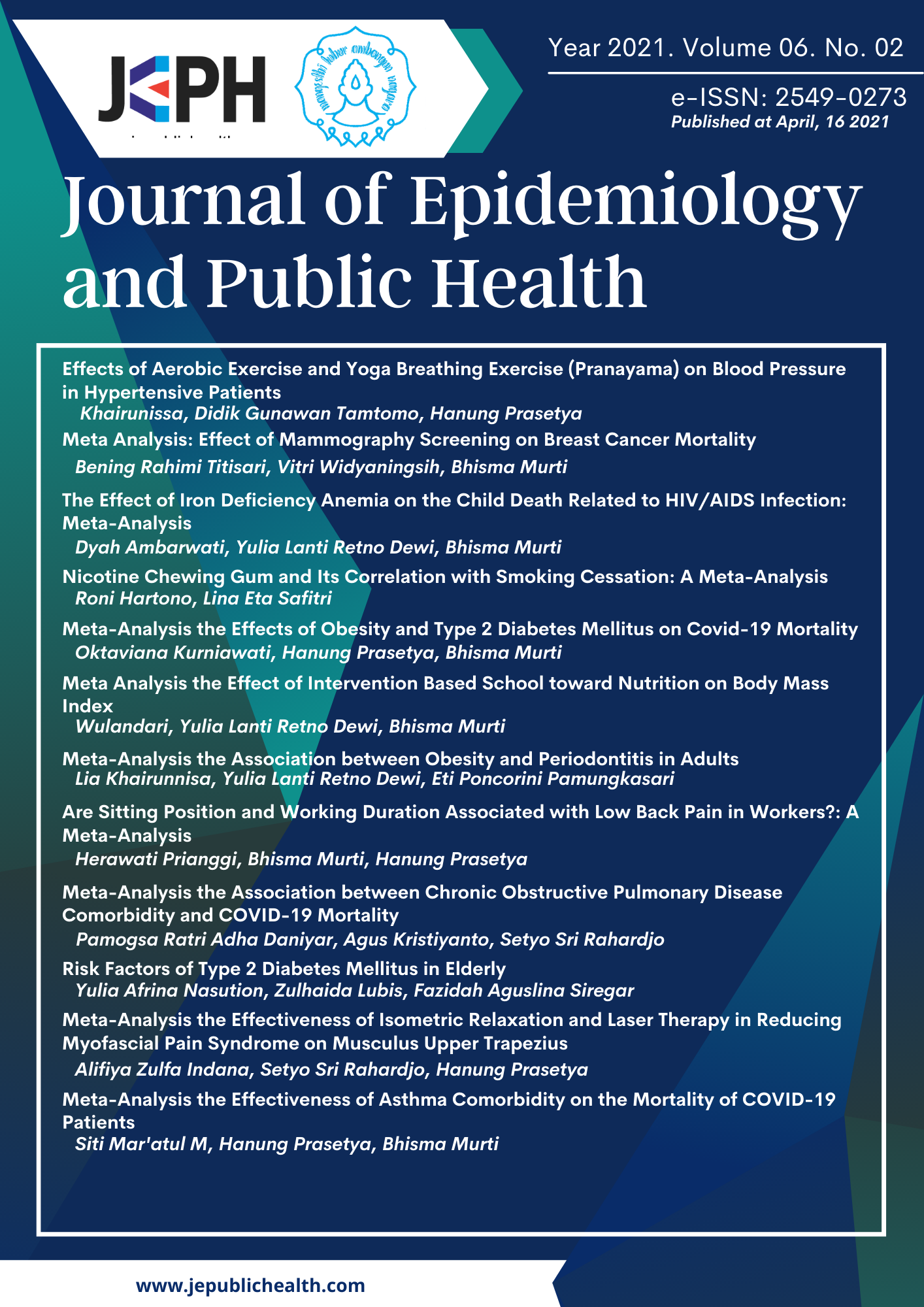
How to Cite
References
Belay MM, Worku A, Gebrie SA, Wamisho BL(2016). Epidemiology of low back pain among nurses working in public hospitals ofAddis Ababa, Ethiopia. East Cent Afr J Surg. 21(1): 113-131. https://doi.org/10.4314/ecajs.v21i1.139040.
Bontrup C, Taylor WR, Fliesser M, Visscher R, Green T, Wippert PM, Zemp R (2019).Low back pain and its relationship with sitting behaviour among sedentary office workers. Appl Ergon. 81: 102894.https://doi.org/10.1016/j.apergo.2019.102894.
Callaghan JP,McGill SM (2001). Low back joint loading and kinematics during standing and unsupported sitting. Ergonomics. 44(3): 280-294. https://doi.org/10.1080/00140130010008110.
Cho IY, Park SY, Park JH, Kim TK, Jung TW, Lee HM (2015). The effect of standing and different sitting positions on lumbar lordosis: Radiographic study of 30 healthy volunteers. Asian Spine J. 9(5): 762
Davis KG, Kotowski SE (2014).Postural variability: an effective way to reduce musculoskeletal discomfort in office work. Hum Factors. 56(7):1249-61. https://doi.org/10.1177/0018720814528003.
Diallo SYK,Mweu MM, Mbuya SO Mwanthi MA (2019). Prevalence and risk factors for low back pain among university teaching staff in Nairobi, Kenya: a cross-sectional study.F100-0Res. 8: 808. https://dx.doi.org/10.12688%2Ff1000research.19384.1.
Goossens RHM, Netten MP, Van der Doelen B (2012). An office chair to influence the sitting behavior of office workers.Work.41(1):2086-8.https://doi.org/10.3233/wor-2012-0435-2-086.
HannaF, Daas RN, El-Shareif TJ, Al-Marridi HH, Al-Rojoub ZM, Adegboye OA (2019).The relationship between sedentary behavior, back pain, and psychosocial correlates among university employees. Front Public Health. 7:80. https://doi.org/10.3389/fpubh.2019.00080.
Inoue G, Miyagi M, Uchida K, Ishikawa T, Kamoda H, Eguchi Y, Orita S, et al., (2015). The prevalence and characteristics of low back pain among sitting workers in a Japanese manufacturing company. J Orthop Sci. 20(1):23
Kawaguchi M, Matsudaira K, Sawada T, Koga T, Ishizuka A, Isomura T, Coggon D (2017). Assessment of potential risk factors for new onset disabling low back pain in Japanese workers: findings from the CUPID (cultural and psychosocial influences on disability)
Kurnia R, Adriani RB, Demartoto A (2016). Association between personal and environmental factors, bodyposition on low back pain at Dr. Moewardi Hospital, in Surakarta.J Health Promot Behav. 1(1): 19-25. https://doi.org/10.26911/thejhpb.2016.01.01.03.
Lena V. Kalling, Victoria B, Bjorn E, Tobias H, Jane S, Gunnar A, Peter W, Elin E (2021). Workplace sitting is associ-ated with self reported ganeral health and back/neck pain: a cross-sectional analysis in 44,978 employees. BMC Public Health. 21:
Liira JP, Shannon HS, Chambers LW, Haines TA (1996). Longterm back problems and physical work exposures in the 1990 Ontario Health Survey. Am J Public Health. 86(3): 382-7. https://doi.org/10.2105/ajph.-86.3.382.
Lis AM,Black KM, Korn H, Nordin M (2007). Association between sitting and occupational LBP. Eur Spine J. 16(2): 283
Matsudaira K, Konishi H, Miyoshi K, Isomura T, Inuzuka K (2014). Potential risk factors of persistent low back pain developing from mild low back pain in urban Japanese workers.PLoS One. 9(4):e93924.https://doi.org/10.1371/journal.pone.0093924.
Min S, Ho-Joong K, Hyunseok J, Hyoungmin K, Bong-Soon C, Choon-Ki L, Jin S (2018). Longer sitting time and low physical activity are closely associated with chronic low back pain in population over 50 year of age: a cross-sectional study using the
Pynt J, Higgs J, Mackey M (2002). Historical perspective milestones in the evolution of lumbar spinal postural health in seating. Spine (Phila Pa 1976). 27(19):2180-9. https://doi.org/10.1097/00007632-200210010-00-020.
Sameh M, Abolfotouh, Karim M, Khaled F, Gameh M, Abir E, Mostafa A, Abolfotouh A (2015). Prevalence, consequences and predictor of low back pain among nurses in a tertiary care setting. SICOT. 39(12):2439-49. doi: 10.1007/s00264-015-2900-x
Spyropoulos P, Papathanasiou G, Georgou-dis G, Chronopoulos E, Koutis H, Koumoutsou F (2007).Prevalence of low back pain in greek public office workers. Pain Physician.10(5):651-9.PMID: 17876361.
Sudholz B, Ridgers ND, Mussap A, Bennie J, Timperio A, Salmon J(2018). Reliability and validity of self-reported sitting and breaks from sittingin the workplace.J Sci Med Sport. 21(7):697-701.https://doi.org/10.1016/j.jsams.2017.10.030.
Tanzil S, Jamali T, Inam B, Abbas A (2019). Frequency and severity of low back pain among healthcare providers and associated factors in a tertiary care, public hospital in Karachi. Occup Med Health Aff. 7(1): 285. https://doi.org/10.4172/2329-6879.1000285.
Mekonnen TH (2019). Work-related factors associated with low back pain among nurse professionals in East and West Wollega Zones, Western Ethiopia, 2017: A cross-sectional. Pain Ther. 8(2): 239-247. https://doi.org/10.10-07/s40122-019-0129-x.
van Deursen DL, Lengsfeld M, Snijders CJ, Evers JJM, Goossens RHM (2000). Mechanical effects of continuous passive motion on the lumbar spine in seating. J Biomech.33(6): 695-699. https://doi.org/10.1016/S0021-9290-(99)00231-6.
van Die
Xu CX, Zhu HH, Fang L, Hu RY, Wang H, Liang MB, Zhang J, Lu F, et al. (2017). Gender disparity in the associations of overweight/obesity with occupational activity, transport to/from work, leisuretime physical activity, and leisure-time spent sitting
Yang H, Haldeman S, Lu ML, Baker D (2016).Low back pain prevalence and related workplace psychosocial risk factors: A study using data from the 2010 National Health Interview Survey. J Manipulative Physiol Ther. 39(7): 459
Most read articles by the same author(s)
- Mutiana Agustin Sholikah, Agus Kristiyanto, Hanung Prasetya, Meta-Analysis the Effect of Constraint-Induced Movement Therapy on Hands Functional Ability and Occupational Performance in Children with Cerebral Palsy , Journal of Epidemiology and Public Health: Vol. 6 No. 1 (2021)
- Deviana Tristian, Bhisma Murti, Argyo Demartoto, Multilevel Analysis: Factors Related with Quality Service of Elderly Community Health Post in Sukoharjo Central Java , Journal of Epidemiology and Public Health: Vol. 9 No. 2 (2024)
- Edi Pramono, Bhisma Murti, Hanung Prasetya, Meta-Analysis the Effect of Protected Well and Measles Vaccination on Stunting in Children Under Five , Journal of Epidemiology and Public Health: Vol. 9 No. 2 (2024)
- Riski Anisa, Yulia Lanti Retno Dewi, Hanung Prasetya, Correlation between Overweight and Mental Health in Adolescents: A Meta Analysis , Journal of Epidemiology and Public Health: Vol. 7 No. 4 (2022)
- Septyandi Ramadhan, Bhisma Murti, Hanung Prasetya, Effect of Exercise on Quality of Sleep in COVID-19 Patients: A Meta-Analysis , Journal of Epidemiology and Public Health: Vol. 8 No. 4 (2023)
- Citra Ayuningtiyas, Agus Kristiyanto, Bhisma Murti, Meta-Analysis Aerobic Exercise Improves Quality of Life in Breast Cancer Survivor , Journal of Epidemiology and Public Health: Vol. 7 No. 2 (2022)
- Adawiyah Putri Diana, Ronald Pratama Adiwinoto, Retno Budiarti, Soedarsono, Hanung Prasetya, Oki Nugraha Putra, Exploring Diabetes Mellitus' Impact on Tuberculosis Outcomes: A Comprehensive Comparative Study , Journal of Epidemiology and Public Health: Vol. 10 No. 2 (2025)
- Alifia Nadhimah Putri, Shafa Latifah, Virdaria Andriani, Bhisma Murti, Siti Mar’atul Munawaroh, Effects of Social Network, Social Trust, and Social Participation on Depression: A Meta-Analysis , Journal of Epidemiology and Public Health: Vol. 9 No. 4 (2024)
- Lestari Indah, Hanung Prasetya, Bhisma Murti, Relationships between Family Support, Gender, and Education on Quality of Life in Elderly in Jambi: Multi-Level Analysis , Journal of Epidemiology and Public Health: Vol. 9 No. 3 (2024)
- Annissa Devi Permata, Bhisma Murti, Didik Gunawan Tamtomo, Hypertension, Gender, Older Age, and Their Relationships with COVID-19 Mortality: Meta-Analysis , Journal of Epidemiology and Public Health: Vol. 6 No. 1 (2021)
Make a Submission
SINTA
Association

information
Information for Author
- Open Access Policy
- License and Copyright
- Article Processing Charge
- Peer Review Process
- Authors’ Guidelines
- Authorship Criteria
- Template for Author
- Publication Ethics
- Conflict of Interest
- Plagiarism Policy
- Policy on the Use of Artificial Intelligence (AI)
- Allegations of Misconduct
- Corrections, Retractions, Article Removal Policy
- Digital Archiving & Preservation Policy
Visitors

Indexing
 |
 |
 |
 |
 |
 |
 |
 |
 |
 |