The Influence of Social Trust, Income Inequality, and Employment Status on the Risk of Depression
DOI:
https://doi.org/10.26911/jepublichealth.2025.10.04.10Abstract
Background: Depressive disorders are among the most common and complex mental health problems worldwide, including in Indonesia. The determinants of depression are closely linked to social and economic factors. This study aimed to estimate the effects of social trust, income inequality, and employment status on the risk of depression.
Subjects and Method: An observational study with a cross-sectional design utilized the fifth wave of the Indonesia Family Life Survey (IFLS5). The dataset includes more than 29,716 individuals across 13 provinces. The sample was selected using a purposive sampling method.
Results: The risk of depression increased significantly among individuals who were unmarried (b = 0.97; 95% CI: 0.84 to 1.07; p < 0.001), female (b = 0.16; 95% CI: 0.06 to 0.26; p = 0.002), unemployed (b = 0.25; 95% CI: 0.14 to 0.35; p < 0.001), and living in provinces with higher income inequality (b = 0.32; 95% CI: 0.21 to 0.42; p < 0.001). Conversely, the risk of depression decreased significantly with higher social trust (b = -0.18; 95% CI: -0.29 to -0.08; p < 0.001), good sleep quality (b = -0.20; 95% CI: -0.21 to -0.19; p < 0.001), older age (b= -0.81; 95% CI: -0.99 to -0.63; p < 0.001), and higher education level (≥senior high school) (b= -0.36; 95% CI: -0.46 to -0.25; p < 0.001).
Conclusion: The risk of depression increases with unmarried, female, unemployed, and living in provinces with higher income inequality. The risk of depression decreases with higher social trust, good sleep quality, older age, and education ≥senior high school.
Keywords:
kepercayaan sosial, ketimpangan pendapatan, risiko depresi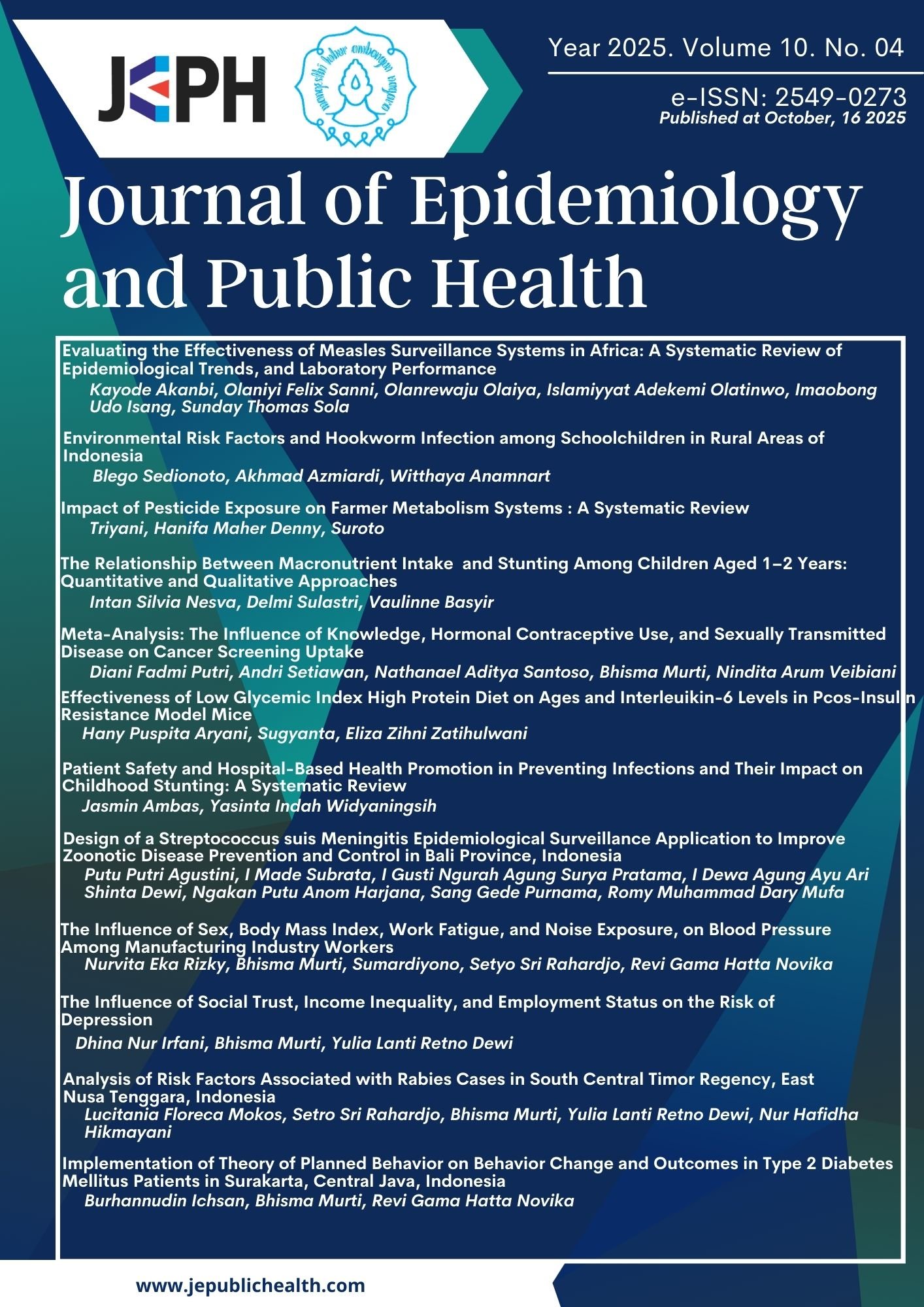
How to Cite
References
Asnani MR, Fraser R, Lewis NA, Reid ME (2010). Depression and loneliness in Jamaicans with sickle cell disease. BMC Psychiatry, 10(1): 40. https://doi.org/10.1186/1471-244X-10-40
Benny C, Patte KA, Veugelers PJ, Leatherdale ST (2023). A longitudinal study of income inequality and mental health among Canadian secondary school students: Results from the Cannabis, Obesity, Mental Health, Physical Activity, and Sedentary Behaviour (COMPASS) Study. J Adolesc Health. https://doi.org/10.1016/j.jadohealth.2023.02.007
Central Bureau of Statistics of Indonesia (2022). Indonesian People’s Welfare Indicators (in Indonesia).
Chang KJ, Son SJ, Lee Y (2014). Perceived sleep quality is associated with depression in a Korean elderly population. Arch Gerontol Geriatr, 59(2): 468–473. https://doi.org/10.1016/j.archger.2014.04.009
Dev S, Kim D (2020). State-level income inequality and county-level social capital in relation to individual-level depression in middle-aged adults. Int J Environ Res Public Health, 17(15): 5386. https://doi.org/10.3390/ijerph17155386
Du X, Jiang F, Yuan S (2025). A cross-sectional study on the correlation between exercise frequency and mental health among university students based on IPAQ classification. Front Psychol. https://doi.org/10.3389/fpsyg.2025.1616970
Gelaye B, Addae G, Neway B (2017). Poor sleep quality, antepartum depression and suicidal ideation among pregnant women. J Affect Disord, 209: 195–203. https://doi.org/10.1016/j.jad.2016.11.044
Haseda M, Kondo N, Ashida T, Tani Y (2018). Community social capital, built environment, and income-based inequality in depressive symptoms among older people in Japan: An ecological study from the JAGES project. J Epidemiol, 28(3): 108–116. https://doi.org/10.2188/jea.JE20160216
Haselbach F (2025). Impact of neighborhood income inequality on adolescents’ mental health: Results from the STARS study. Health Place, 82. https://doi.org/10.1016/j.healthplace.2024.103096
IFLS (2015). Indonesia Family Life Survey (IFLS-5): Overview and User Guide. https://www.rand.org/wellbeing/social-and-behavioral-policy/data/FLS/IFLS/ifls5.html
Kongsomboon K (2021). Factors affecting depression in workplace: marital status, BMI, stress level, work duration, job pattern, and daytime sleepiness. Chula Med J, 55(2). https://digital.car.chula.ac.th/clmjournal/vol55/iss2/3/
Lu Y, Zhang J, Zhou Z, He R, Zhu B, Mao Y (2025). Age-specific associations between intergenerational support from children and depression in middle-aged and elderly Chinese. Front Psychol. https://www.frontiersin.org/articles/10.3389/fpsyg.2025.1621444/full
Magakwe TS (2025). Association between educational attainment and mental health conditions among Africans working and studying in selected African countries. Scientific Reports. https://www.nature.com/articles/s41598-025-05831-2
Mulyani NH (2023). Meta-Analysis: The Effect of Family Support, Household Income, and Domestic Violence on the Risk of Postpartum Depression (in Indonesia). Thesis. Universitas Sebelas Maret. https://digilib.uns.ac.id/dokumen/download/103614
Rozana Y, Maharani D (2021). Pengaruh penerapan terapi kelompok life review terhadap tingkat depresi lansia di wilayah kerja Puskesmas Salo.
Shafipour V, Jafari H, Firoz MN (2015). Sleep quality and depression and their association with other factors in hemodialysis patients. Glob J Health Sci, 8(6): 121. https://doi.org/10.5539/gjhs.v8n6p121
Sulaiman ES (2021). Pemberdayaan Masyarakat di Bidang Kesehatan: Teori dan Implementasi. Books Google. https://books.google.com/books?id=qOpIEAAAQBAJ
WHO (2023). Depressive disorder (depression). Accessed from https://www.who.int/news-room/fact-sheets/detail/depression
Xiong X, Zhan N, Zou J, Xu F, Geng F (2025). Factor structure and measurement invariance of DERS-16 across gender and age groups in China. Pers Individ Differ. https://www.sciencedirect.com/science/article/pii/S0191886925003058
Yang XK (2025). The impact of community health care services on the mental health of older adults in China. BMC Health Serv Res. https://www.ncbi.nlm.nih.gov/pmc/articles/PMC12217278/
Yanti Y, Laila A, Husna RK (2018). Faktor yang berhubungan dengan kejadian depresi antenatal pada ibu hamil di BPM Kota Pekanbaru Tahun 2017. Jurnal Ibu dan Anak. https://jurnal.pkr.ac.id/index.php/JIA/article/download/110/93
Zhang Z, Xu H, Zhang R, Yan Y, Ling X, Meng Y (2025). Frailty and depressive symptoms in relation to cardiovascular disease risk in middle-aged and older adults. Nature Communications. https://www.nature.com/articles/s41467-025-61089-2
Zimmerman FJ, Katon W (2015). Socioeconomic status, depression disparities, and financial strain: What lies behind the income-depression relationship? Health Economics, 14(10): 957–970. https://doi.org/10.1002/hec.1011