Meta-Analysis: The Influence of Knowledge, Hormonal Contraceptive Use, and Sexually Transmitted Disease on Cancer Screening Uptake
DOI:
https://doi.org/10.26911/jepublichealth.2025.10.04.05Abstract
Background: Cervical cancer is still the most common problem among women. Prevention of cervical cancer can be done prospectively through human papillomavirus (HPV) vaccination and screening or early diagnosis. Screening is essential to reduce the incidence and death of cervical cancer. This study aims to analyze and estimate the influence of knowledge, the use of hormonal contraceptives, and the history of sexually transmitted diseases on cervical cancer screening.
Subject and Method: This study is a meta analysis using the PRISMA flowchart and the PICO model. Population: women of childbearing age. Intervention: using hormonal contraceptives, having good cervical cancer knowledge, and having a history of sexually transmitted infections. Comparation: not using hormonal contraceptives, poor cervical cancer knowledge and no history of sexually transmitted infections. Outcome: cervical cancer screening. The process of searching for articles by searching through databases in Google scholar, Scopus, ProQuest, PubMed, Elsevier, and Science direct. The keywords used are "hormonal contraception" OR "pill" OR "injection" OR "implant" AND "Cervical cancer screening" OR "sexually transmitted infection" OR "HIV" OR "STD" OR "syphilis" OR "gonorrhea" AND "cancer knowledge" AND "cross sectional" AND "aOR". Articles are selected based on inclusion criteria, namely multivariate articles with a cross sectional design published in 2014-2024. Data analyzed using Revman 5.3.
Results: A meta analysis was conducted on 15 primary studies from Ethiopia, Cambodia, and Uganda. The results showed that the use of cervical cancer screening increased with good knowledge (aOR= 2.03; CI 95%= 1.70 to 2.43; p<0.001), use of hormonal contraceptives (aOR= 1.83 CI 95%= 1.70 to 1.96; p<0.001), and history of sexually transmitted diseases (aOR= 2.32; CI 95%= 1.81 to 2.97; p<0.001).
Conclusion: Good knowledge, use of hormonal contraceptives, and history of infectious diseases increase the use of cervical cancer screening performance
Keywords:
sexually transmitted diseases, cervical cancer, hormonal contraceptives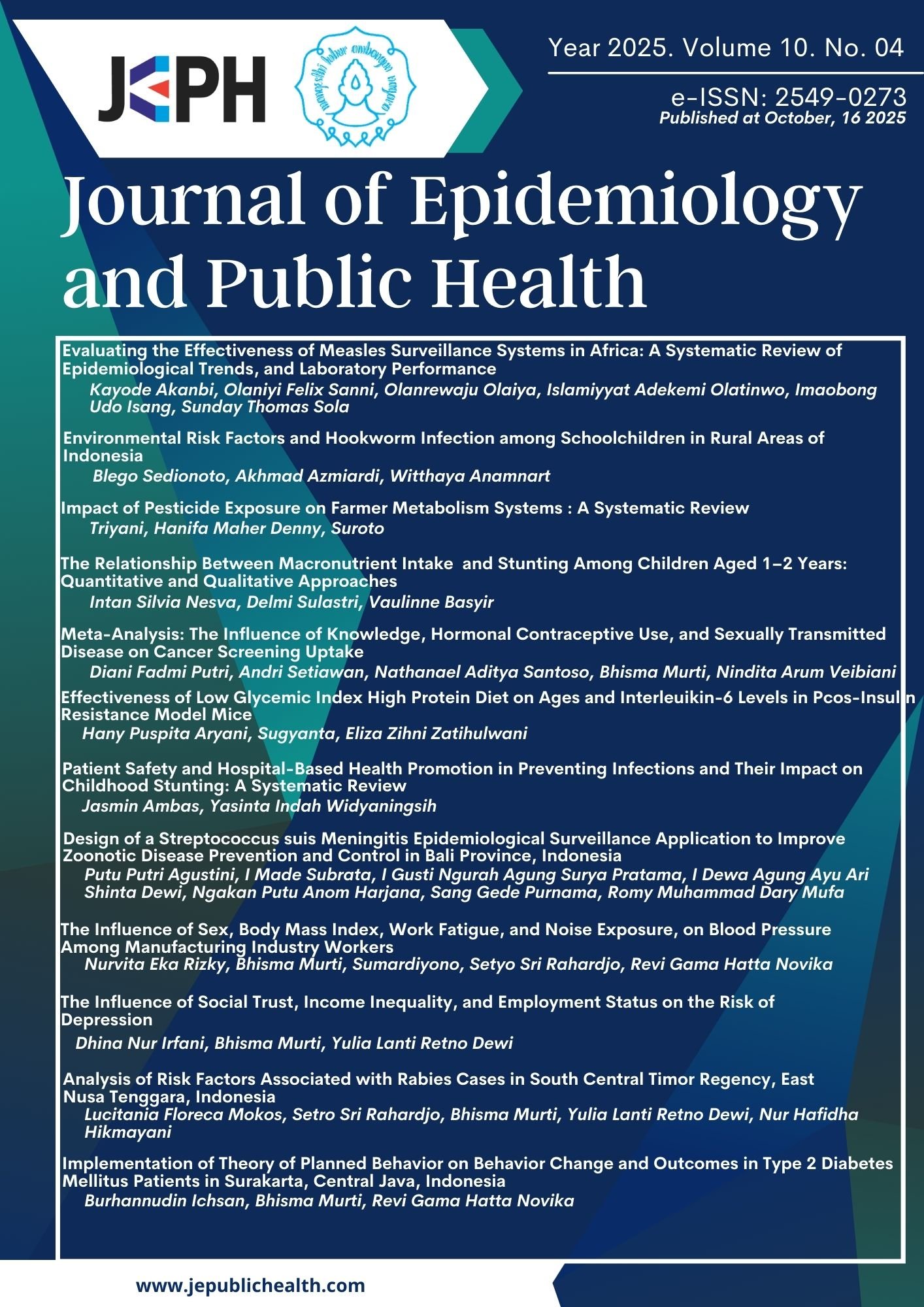
How to Cite
References
Mohammed ZK, Amare YW, Getahun MS, Negussie YM, Gurara A (2023). Cervical cancer screening service utilization and associated factors among women living with HIV receiving antiretroviral therapy at Adama Hospital Medical College, Ethiopia. SAGE Open Nurs. 9: 1–8. doi: 10.1177/23779608231152072.
Abera GB, Abebe SM, Werku AG (2020). Demand for cervical cancer screening in Tigray region of Ethiopia in 2018: A community based cross sectional study. Int J Women’s Health. 12: 795–804. doi: 10.2147/IJWH.S255548.
Amado G, Weldegebreal F, Birhanu S, Dessie Y (2022). Cervical cancer screening practices and its associated factors among females of reproductive age in Durame town, Southern Ethiopia. PLoS ONE. 17(12): 1–14. doi: 10.1371/journal.pone.0279870.
Assefa AA, Feleke T, Tsadik S, Degela F, Zenebe A, Abera G (2024). Utilization and associated factors of cervical cancer screening service among eligible women attending maternal health services at Adare General Hospital, Hawassa city, Southern Ethiopia. Sci Rep. 14(1): 2774. doi: 10.1038/s41598-024-52924-5.
Aynalem BY, Anteneh KT, Enyew MM (2020). Utilization of cervical cancer screening and associated factors among women in Debremarkos town, Amhara region, Northwest Ethiopia: Community based cross-sectional study. PLoS ONE. 15(4): 1–13. doi: 10.1371/journal.pone.0231307.
Bante SA, Getie SA, Getu AK, Mulatu K, Fenta SL (2019). Uptake of precervical cancer screening and associated factors among reproductive age women in Debre Markos town, Northwest Ethiopia, 2017. BMC Public Health. 19(1): 1102. doi: 10.1186/s12889-019-7398-5.
Chali K, Oljira D, Sileshi T, Mekonnen T (2021). Knowledge on cervical cancer, attitude toward its screening, and associated factors among reproductive age women in Metu Town, Ilu Aba Bor, South West Ethiopia, 2018: Community based cross-sectional study. Cancer Reports. 4(5): e1382. doi: 10.1002/cnr2.1382.
Christensen AJ, Mwaji J, Mbabazi J, Juncker M, Kalletrup P, Kraef C (2023). Fighting cervical cancer in Africa: A cross-sectional study on prevalence and risk factors for precancerous lesions in rural Uganda. BMC Public Health. 225: 87–95. doi: 10.1016/j.puhe.2023.09.023.
Damtie S, Legese B, Berhan A, Kiros T, Eyayu T, Mihrete K, Taklual W (2023). Knowledge, attitude, and practice of cervical cancer screening and its associated risk factors among family planning service users at Debre Tabor town health facilities, North Central Ethiopia: A cross-sectional study. Medicine. 11. doi: 10.1177/20503121231208654.
Dangal G, Dhital R, Dwa YP, Poudel S, Pariyar J, Subedi K (2024). Implementation of cervical cancer prevention and screening across five tertiary hospitals in Nepal and its policy implications: A mixed-methods study. PLOS Glob Public Health. 4(1): e0002832. doi: 10.1371/journal.pgph.0002832.
Desta AA, Alemu FT, Gudeta MB, Diria DE, Kebede AG (2022). Willingness to utilize cervical cancer screening among Ethiopian women aged 30–65 years. Front Glob Womens Hlt. 3. doi: 10.3389/fgwh.2022.939639.
Endalew DA, Moti D, Mohammed N, Redi S, Alemu BW (2020). Knowledge and practice of cervical cancer screening and associated factors among reproductive age group women in districts of Gurage zone, Southern Ethiopia: A cross-sectional study. PLoS One. 15(9): e0238869. doi: 10.1371/journal.pone.0238869.
Jemal Z, Chea N, Hasen H, Tesfaye T, Abera N (2023). Cervical cancer screening utilization and associated factors among female health workers in public health facilities of Hossana town, Southern Ethiopia: A mixed method approach. PLoS One. 18(5): e0286262. doi: 10.1371/journal.pone.0286262.
Lemma D, Aboma M, Girma T, Dechesa A (2022). Determinants of utilization of cervical cancer screening among women in the age group of 30–49 years in Ambo Town, Central Ethiopia: A case-control study. PLoS One. 17(7): 1–15. doi: 10.1371/journal.pone.0270821.
Mekuria M, Edosa K, Endashaw M, Bala ET, Chaka EE, Deriba BS, Tesfa B (2021). Prevalence of cervical cancer and associated factors among women attended cervical cancer screening center at Gahandi Memorial Hospital, Ethiopia. Cancer Inform. 20. doi: 10.1177/11769351211068431.
Mesfin AH, Gufue ZH, Alemayehu MA, Kedida BD, Legese B, Gejo NG (2023). Usage of cervical cancer screening services among HIV-positive women in Southern Ethiopia: A multicentre cross-sectional study. BMJ Open. 13. doi: 10.1136/bmjopen-2022-068253.
Misgun T, Demissie DB (2023). Knowledge, practice of cervical cancer screening and associated factors among women police members of Addis Ababa police commission Ethiopia. BMC Cancer. 23: 961. doi: 10.1186/s12885-023-11478-x.
Mukama T, Ndejjo R, Musabyimana A, Halage AA, Muoke D (2017). Women’s knowledge and attitudes towards cervical cancer prevention: A cross sectional study in Eastern Uganda. BMC Women’s Health. 17(1): 1–8. doi: 10.1186/s12905-017-0365-3.
Musonda JS, Sodo PP, Yusuf OA, Reji E, Musonda J, Mabuza LH, Ndimanda JV, et al. (2022). Cervical cancer screening in a population of black South African women with high HIV prevalence: A cross-sectional study. PLOS Glob Public Health. 2(11): e0001249. doi: 10.1371/journal.pgph.0001249.
Phaiphichit J, Paboriboune P, Kunnavong S, Chanthavilay P (2022). Factors associated with cervical cancer screening among women aged 25–60 years in Lao People’s Democratic Republic. PLoS One. 17: 1–11. doi: 10.1371/journal.pone.0266592.
Saimin J, Wicaksono S, Ashaeryanto (2018). Cervical cancer screening coverage in urban and rural area: Its determinants. J Med Sci. 50(3): 357–363. doi: 10.19106/jmedsciesup005001201806.
Tadesse F, Megerso A, Mohammed E, Nigatu D, Bayana E (2023). Cervical cancer screening practice among women: A community based cross-sectional study design. Inquiry. 60. doi: 10.1177/00469580231159743.
Toru T, Zeleke B, Tegegn T, Birlew T (2022). Cervical cancer screening utilisation and associated factors among women aged 30 years and above in Southern Ethiopia: Cross-sectional study. South Afr J Gynaecol Oncol. 14(1): 10–15. doi: 10.36303/SAJGO.2022.14.1.368.
Um ALO, Oseely S, Manaf R, Ismail S (2023). Factors affecting cervical cancer screening among Yemeni immigrant women in Klang Valley, Malaysia: A cross-sectional study. PLoS ONE. 18(12): 1–13. doi: 10.1371/journal.pone.0290152.
Vigneshwaran E, Goruntia N, Bommireddy BR, Mantargi MJS, Mopuri B, Thammisetty DP, Veerabhadrappa KV, et al. (2023). Prevalence and predictors of cervical cancer screening among HIV-positive women in rural Western Uganda: Insights from the health belief model. BMC Cancer. 23(1): 1–16. doi: 10.1186/s12885-023-11683-8.
Yimer NB, Mohammed MA, Solomon K, Tadese M, Grutzmacher S, Meikena HK, Alemnew B, et al. (2021). Cervical cancer screening uptake in Sub-Saharan Africa: A systematic review and meta-analysis. BMC Public Health. 195: 105–111. doi: 10.1016/j.puhe.2021.04.014.